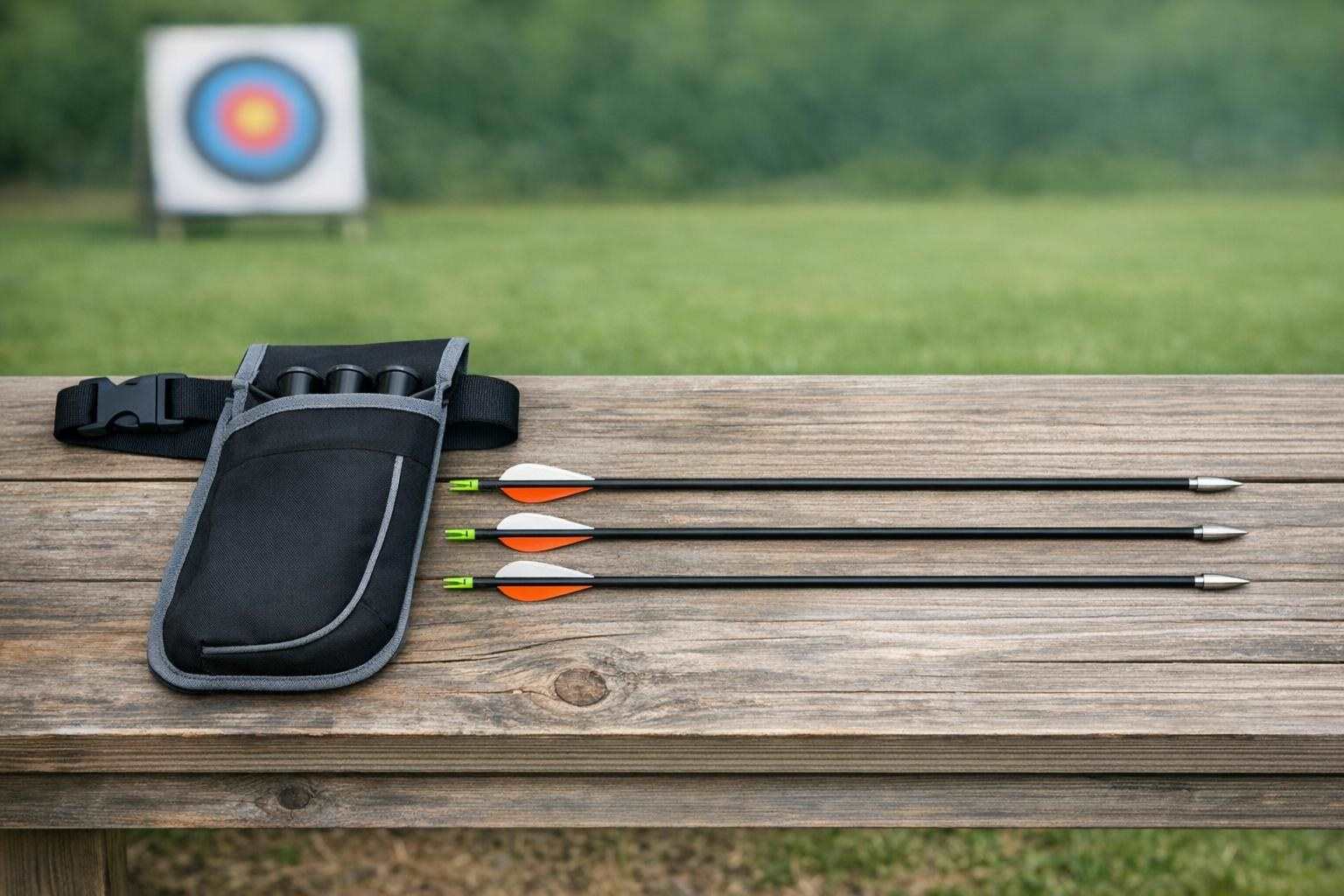
Most archery practice Shooting includes shot after shot from a single position – sometimes even from the same distance from the target. To accommodate such shooting practice a quiver would be worn as an Archery accessory in between practice shots. Some archers prefer shooting from a standing position with arrows stored in the quiver on their belt, whilst others prefer shooting from a bowhanger which has been set up for them, with their arrows stored in a quiver which has been attached to the bow.
Start with the way you practice
Consider your practice routine first. If you shoot from a variety of locations, a carrier that you leave at the shooting location would be better than one that you have to carry with you. Consider where you keep your spare arrows, and how you currently retrieve arrows for your next shot. If you shoot from one fixed location, consider a bow-mounted quiver. If you shoot from a variety of locations, consider a hip quiver.
An archery quiver on your body can be very convenient, as it allows arrows to be quickly picked up. That's very important for target practice when you want your bow-hand to be in exactly the same position every time you shoot. A bow-mounted quiver, on the other hand, keeps your arrows with your archery equipment. However, the extra weight can be a problem and cause vibration.
A good archery quiver is not just about the amount of arrows it holds. A holder that is too full can become very bulky and may not be as comfortable to wear as you would hope. On the other hand, a holder that is too small may cause you to have to carry loose arrows and make many trips back to your archery equipment.
Compare hip and bow-mounted designs
So, a good place to start looking for a quiver to use for your target practice would be to look at the hip quivers first. Most of these models are designed to be worn on the dominant side of your body or the opposite side. So, find a comfortable position for shooting, and then bend, walk and rotate to see how the quiver will behave while you are practicing. Does it dig into your hip? Will it swing from side to side while you are turning? Will it get caught in your jacket?
Bow-mounted quiver: The mass of the quiver(s) and the hardware will affect the way your bow shoots. And, as with any quiver, loose hardware can cause problems as it moves about when shooting. Also ensure that the mounting points are secure and that the arrows won't touch the bow's strings and cables, as well as any sights and other moving parts.
A target practice quiver can be a free standing unit placed near your shooting position. It might even be left on the ground, but this would not be suitable for someone who walks between shooting positions. Consider the time before and after a shot.
Check arrow fit before comfort
The shafts need to be held securely in the arrow compartment of the bow accessory without being pressed against the fletching. Place the arrows that you use for target practice in the carrier, and check for contact points. Bends in the vane or even scuffing can occur if the vanes of the arrows are in contact with each other. The same can happen with the feathers of fixed blades if they are pressed against the seams or against fastening parts of the bow accessory.
The noise that an archery quiver makes is important. While not necessarily a problem, a rattle could indicate some loose arrows or a holder that moves about within the carrier. For ethical bowhunting shot from hiding, all such problems must be found and remedied before use.
Arrow points should remain within the compartment and not come into contact with your clothing, your hands or any other piece of equipment. In the unlikely event that an arrow point were to come into contact with any of these it could potentially cause damage. Also be wary of any cracked stitching or split plastic as well as any bare metal edges.
Test the fit in real clothing
Before you test the fit of a quiver over thin clothing such as T-shirts, practice with the clothing you normally wear such as woolly jumpers, coats, etc. Get down on your hands and knees, try drawing your bow, and walk about. The quiver needs to feel comfortable after a few minutes. After that, pay attention to any areas that are putting pressure on your skin. Hard edges, tight straps, etc. that after time begin to dig into your clothes could cause you to change your posture to alleviate any discomfort. These changes could lead to inconsistencies with your anchoring or hastening your shooting.
When you try out a new archery quiver, don't try it out just for a few minutes. Take it for a longer test run to feel any uncomfortable pressure points. It could be a hard edge, or a twisted strap, or a clip in a pocket that's digging in. These kinds of things can cause you to change your posture in ways you're not even aware of. And these new postures can cause problems with your archery, leading to inconsistent anchoring and shots that you rush.
A comfortable piece of archery gear is one that does not need to be drawn to your attention. If you keep having to touch, lift or re-adjust your quiver then even though it may look nice as a piece of equipment it is not the right one for you.
Inspect attachment points and moving parts
Before you go out for a session of practice, check your arrow carrier for any signs of wear and tear before you go out to practice. Look for any signs of wear and tear on the belt loops, any signs of wear and tear on the clips, any signs of wear and tear on the straps, any signs of wear and tear on the fasteners, any signs of wear and tear on the stitching. Also check any moving parts of the bow carrier for any signs of wear and tear before you go out to practice.
Follow the bow and quiver manufacturers' instructions when checking clearance around the string and cables. Don't drill, grind, sharpen or modify the mounting point(s) to make an otherwise mediocre item fit. Take advice from the manufacturer of the item to which you're going to attach the quiver as well as the maker of the quiver itself.
Be sure to stop using the accessory part should it get damaged in any way. While tape can be used in the short term to hold a loose flap etc. this is not a permanent solution and must be replaced as soon as possible with a properly fitting alternative.
Keep storage and maintenance simple
Make sure you can easily empty out the holder after your sessions for storage. Also ensure that when cleaning your quiver for storage that you follow the special cleaning instructions for that material if they are provided. If not then use the lightest means possible to clean the quiver and allow it to completely dry before storing it.
Storing your damaged storage equipment in a cold, dark place, such as a garage, to try to dry it out is NOT the best solution. In addition, do not store your storage equipment under other equipment such as hiking boots, sleeping bags, etc. The damage to your storage equipment could easily continue under such circumstances.
Once you have chosen a holder, remember that its main purpose is to remain silently in position whilst you practice, and to be easily inspected before and after each shot. If, as you practice, you find that your arrows, clothing, bow etc. change in some respect, then go back and reinspect your choice of holder. It should support you in your practice and not become another problem with which to cope.